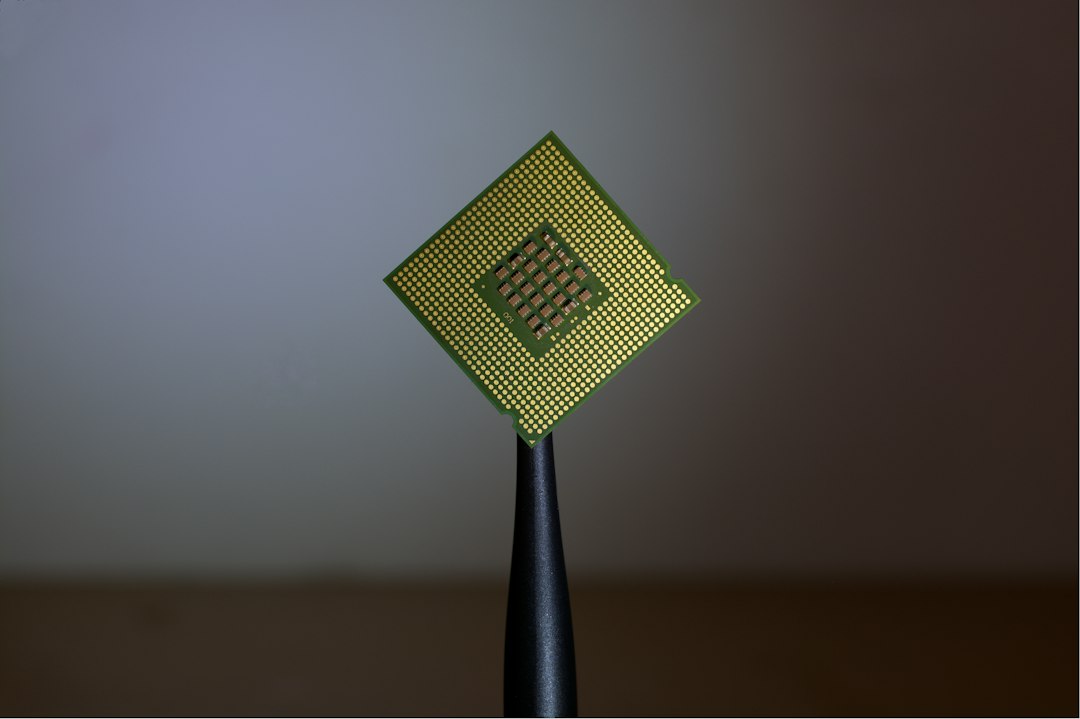
Photo by Brian Kostiuk on Unsplash
Context Switching: The Hidden Tax on Multitasking
Every time your operating system switches from one running process to another, it pays a tax. The CPU must save the entire architectural state of the current process—registers, program counter, stack pointer, memory mappings—and load the state of the next one. This operation, called a context switch, happens thousands of times per second on a busy system, and the cumulative cost shapes how we design everything from schedulers to concurrency models.
What Gets Saved and Restored
A context switch isn’t just swapping a few registers. The kernel must preserve the complete execution context: general-purpose registers, floating-point and SIMD registers, the instruction pointer, stack pointers for both user and kernel mode, and control registers that govern page tables and privilege levels. On x86-64, this means saving and restoring around 30 general and system registers, plus up to 512 bytes of AVX-512 state if the process uses vector instructions.
Beyond registers, the memory management unit needs updating. Each process has its own virtual address space, so switching means loading a new page table base pointer and flushing cached translations in the TLB. Modern architectures tag TLB entries with address space identifiers to avoid full flushes, but some invalidation is still necessary, and the new process will experience TLB misses until its working set is warm.
The Indirect Costs
The direct overhead of saving and restoring registers is measurable but modest—typically a few hundred nanoseconds on modern hardware. The real cost comes from cache pollution. When process A is running, its code and data fill the CPU caches. A switch to process B evicts those cache lines, replacing them with B’s working set. When the scheduler eventually returns to A, it suffers cold-cache misses until it reloads its data from main memory, a penalty that can dwarf the register manipulation time.
This cache thrashing is why context switches hurt more on workloads with large working sets. A process that touches hundreds of megabytes has no hope of keeping it all cache-resident after being swapped out. The problem compounds on NUMA systems, where memory locality matters: if the scheduler migrates a thread to a different socket, it now accesses memory across the interconnect rather than from local DRAM, multiplying latency.
Scheduler Strategies
Operating system schedulers are keenly aware of this cost and make explicit tradeoffs. Linux’s Completely Fair Scheduler tries to keep threads on the same CPU to preserve cache warmth, using per-CPU run queues and only migrating threads when imbalance is severe. The scheduler tracks how much CPU time each task has received and makes decisions at tick interrupts, typically every 1-4 milliseconds, but may defer context switches if the current task is cache-hot and the waiting task can tolerate a brief delay.
Some systems use cooperative multitasking to avoid involuntary switches entirely, relying on tasks to yield explicitly. This eliminates preemption overhead but requires all code to be well-behaved—one long-running computation can starve everything else. Preemptive schedulers trade fairness and responsiveness for the cost of interrupting tasks mid-execution.
Application-Level Implications
The expense of context switching drives architectural decisions. Thread-per-request servers scale poorly past a few thousand threads because the scheduler thrashes between them. Event loops and async I/O models keep execution within a single thread or small thread pool, trading complexity for reduced switching. User-space threading libraries like goroutines and virtual threads multiplex many lightweight tasks onto a small set of OS threads, amortizing context switch costs.
Latency-sensitive applications go further, pinning threads to specific CPUs and disabling scheduler preemption to guarantee uninterrupted execution. High-frequency trading systems and real-time control loops can’t tolerate even microsecond-scale jitter from an untimely context switch.
Toward Lower Overhead
Hardware evolves to minimize switching costs. Tagged TLBs, larger caches, and per-core L2 caches reduce the penalty of interleaving workloads. Intel’s hardware-assisted virtualization and ARM’s nested paging reduce the cost of switching between virtual machines by eliminating some software-managed state.
Software innovations like io_uring batch system calls to reduce kernel crossings, and eBPF moves logic into the kernel to avoid user-kernel context switches entirely. The goal is always the same: do more work per switch, or switch less often.
Context switching remains a fundamental cost of multitasking. You can’t eliminate it, but understanding where the time goes—and why cache effects dominate—shapes how you structure concurrent systems and where you spend optimization effort.