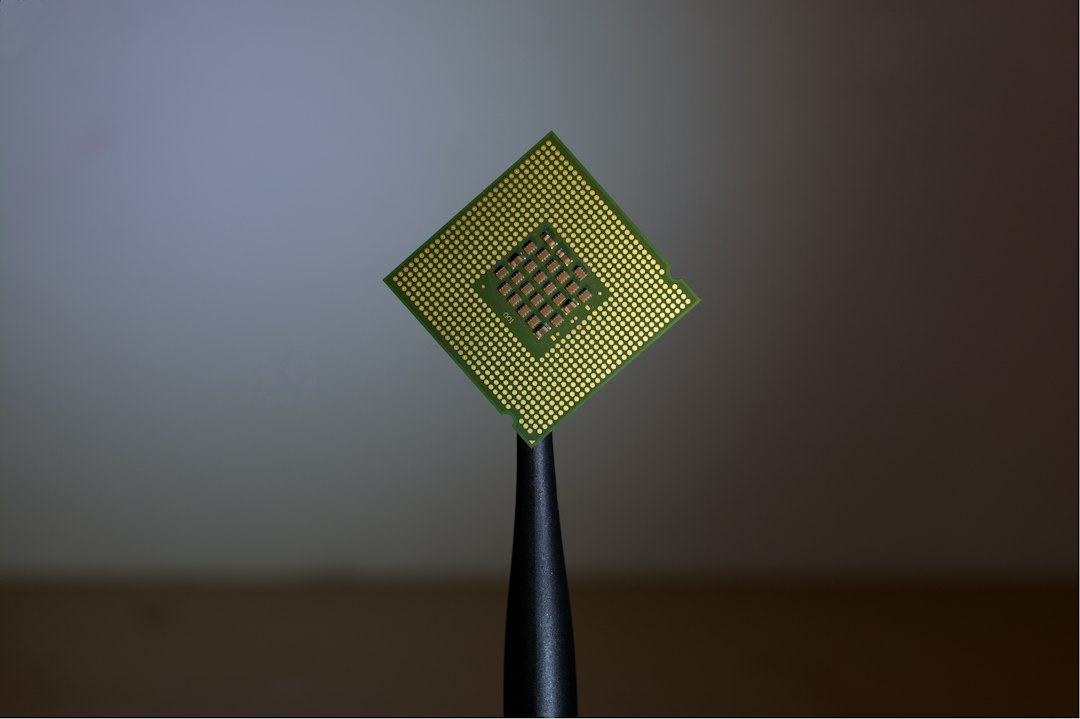
Photo by Brian Kostiuk on Unsplash
CPU Microcode Updates: Patching Silicon After Shipment
Modern CPUs ship with bugs. Not software bugs that live in your kernel or application code, but flaws etched into silicon—incorrect instruction behavior, edge cases in branch prediction, or security vulnerabilities in speculative execution. Once a chip leaves the fab, the gates are fixed. Yet somehow, Intel and AMD routinely patch these hardware-level issues without recalling millions of processors. The mechanism is microcode: a firmware layer between instruction sets and silicon that can be updated at runtime.
What Microcode Actually Does
When your CPU executes an x86 instruction like ADD or MOV, it doesn’t directly manipulate transistors. Complex instructions are first translated into sequences of simpler micro-operations that the execution units understand. This translation layer is microcode—effectively a ROM lookup table and state machine stored on-chip. For straightforward instructions, microcode might be a single micro-op. For complex ones like string operations or certain floating-point cases, it expands into dozens.
Microcode sits in a small on-die ROM, but modern CPUs also include a writable patch RAM. During boot, the BIOS or operating system can load a microcode update into this patch area. When the CPU encounters an instruction, it checks the patch RAM first. If a newer micro-op sequence exists for that instruction, the patched version runs instead of the ROM default. This indirection allows manufacturers to fix incorrect behavior, plug side-channel vulnerabilities, or disable broken features after chips have shipped.
Why Updates Are Necessary
Microcode updates typically address three categories of issues. First, functional bugs: rare instruction sequences that produce wrong results, often discovered only after millions of units are in the field. Second, performance corrections: adjustments to prefetchers, branch predictors, or cache behavior that prevent pathological slowdowns. Third, and most visible in recent years, security mitigations. Spectre, Meltdown, and their variants required microcode changes to flush speculative state, add new instructions for isolation, or disable risky predictors.
Each update trades something. Security patches often reduce performance by adding serialization points or flushing pipeline state. Bug fixes might disable an optimization or force a slower fallback path. Microcode can’t add transistors or rewire execution units—it can only change how existing hardware is orchestrated. The patch layer has limited capacity, so only critical fixes make it in.
How Updates Are Delivered
Microcode updates follow two main paths. BIOS updates bundle them into firmware, loading the patch during POST before the OS boots. Alternatively, operating systems can apply microcode directly at startup using kernel modules. Linux distributions ship Intel and AMD microcode packages that the kernel loads early in the boot sequence. Windows includes microcode in cumulative updates.
The patches are CPU-model-specific, identified by family, model, and stepping numbers. A microcode file contains multiple versions, and the loader selects the correct one by reading CPUID. The update is not persistent—it lives only in volatile patch RAM. Every reboot requires reloading, which is why both BIOS and OS-level delivery exist. If the BIOS has an outdated or missing update, the OS can still apply the latest version.
Performance and Behavioral Impact
Microcode updates are conservative. They rarely change the semantics of correct code, but they can alter timing, expose previously hidden race conditions, or interact poorly with performance assumptions. The Spectre mitigations, for example, introduced new instructions like IBPB and IBRS that force branch predictor flushes. Software had to be updated to use them, and even then, context switch costs increased measurably.
Some updates disable features outright. Hyper-threading has been restricted or turned off in certain configurations to close side channels. Prefetchers have been dialed back when they leaked data across security boundaries. Each change reflects a judgment call: the cost of leaving a vulnerability open versus the performance penalty of closing it.
The Limits of Patching Hardware
Microcode updates work because x86 instructions are already decoded into micro-ops. RISC architectures with simpler, more direct instruction encodings have less room for this kind of post-silicon flexibility. ARM processors use a different update mechanism, often tied to firmware rather than runtime patch RAM. RISC-V, being newer and open, is still defining how microcode-like updates will work across implementations.
Even on x86, microcode can’t fix everything. It can’t repair a broken cache coherence protocol, correct a transistor-level timing violation, or add missing vector units. It’s a workaround layer, not a redesign tool. When bugs are too deep, the only real fix is a new stepping or a new chip entirely.
Microcode updates are a pragmatic admission: even silicon has bugs, and sometimes the most reliable hardware still needs a patch.