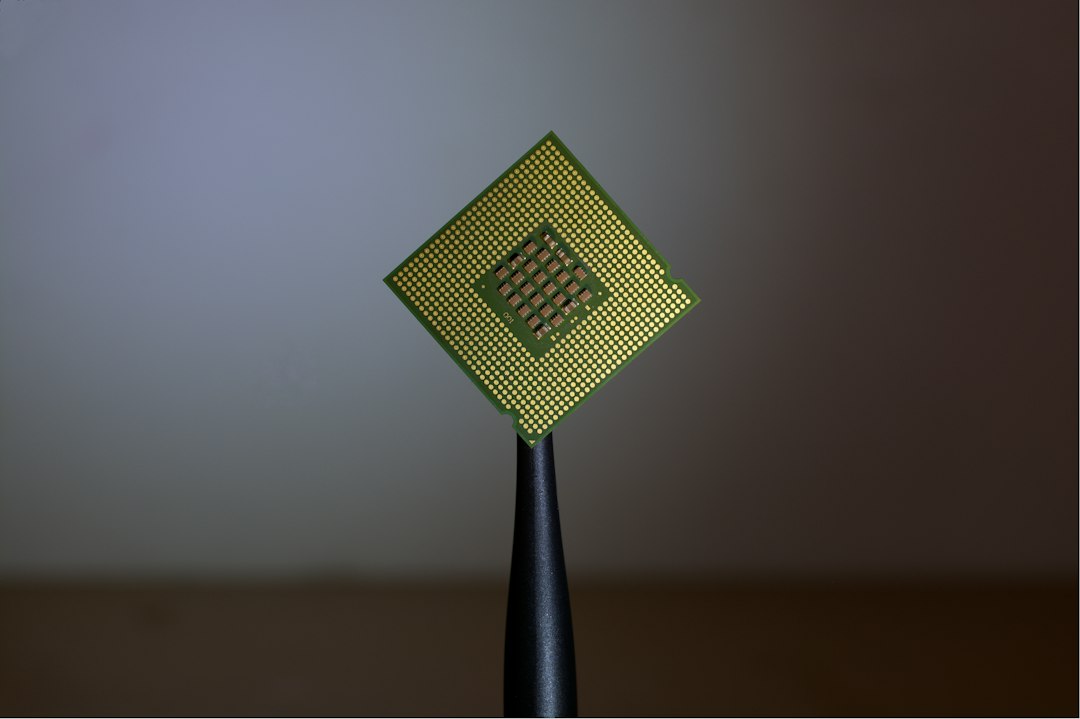
Photo by Brian Kostiuk on Unsplash
CPU Pipeline Depth: The Speculation Tax
Modern CPUs use instruction pipelines to achieve high clock frequencies and throughput, but the depth of those pipelines creates a fundamental tradeoff. A deeper pipeline enables higher frequencies by breaking instruction execution into more stages, but it also increases the penalty for incorrect speculation, mispredicted branches, and context switches. Understanding pipeline depth helps explain why some workloads run slower on newer, ostensibly faster processors.
Pipeline Depth and Clock Speed
A CPU pipeline divides instruction execution into discrete stages: fetch, decode, execute, memory access, and write-back. Deeper pipelines split these stages further, allowing each stage to complete faster and the processor to run at higher clock speeds. The original Pentium used a 5-stage pipeline. The Pentium 4’s NetBurst architecture pushed to 20-31 stages, enabling clock speeds above 3 GHz but creating severe penalties when the pipeline had to flush.
Modern designs settle around 14-20 stages for high-performance cores, balancing frequency gains against speculation costs. Efficiency cores often use shorter pipelines, trading peak frequency for better power efficiency and lower misprediction penalties.
The Cost of Being Wrong
When a branch mispredicts or an exception occurs, the pipeline must flush all speculatively executed instructions. In a 5-stage pipeline, you lose roughly 5 cycles. In a 20-stage pipeline, that same misprediction costs 20 cycles or more. Since modern CPUs execute multiple instructions per cycle when running smoothly, a single misprediction can erase dozens of instructions worth of work.
Branch predictors mitigate this by correctly guessing branch outcomes 95-99% of the time for typical code. But that remaining 1-5% still matters, especially in workloads with unpredictable control flow: parsers, interpreters, compression algorithms, and data-dependent business logic. Even a 99% prediction rate means one flush per 100 branches, and branch-heavy code can execute a branch every few instructions.
Context Switch Amplification
Context switches and system calls also pay the pipeline depth tax. When the CPU switches privilege levels or contexts, it must drain or flush the pipeline to enforce security boundaries and maintain correct architectural state. A deeper pipeline means more in-flight work is discarded.
This affects latency-sensitive services and microservices that make frequent system calls for I/O, especially when using synchronous blocking models. Kernel bypass techniques and user-space networking stacks (DPDK, io_uring) partially avoid this by reducing the frequency of privilege transitions, keeping the pipeline full and productive.
Impact on Instruction-Level Parallelism
Deeper pipelines depend on instruction-level parallelism (ILP) to keep all stages busy. The CPU’s out-of-order execution logic looks ahead to find independent instructions, but control flow boundaries limit this visibility. A mispredicted branch doesn’t just waste the pipeline—it also collapses the window of instructions available for parallel execution, forcing the processor to rebuild that window from scratch after the flush.
Code with frequent unpredictable branches suffers twice: from the pipeline flush and from the collapsed instruction window. This explains why tight loops with simple, predictable control flow often outperform equivalent logic spread across many conditionals, even when both perform the same number of operations.
Design Choices and Tradeoffs
Intel’s move away from the Pentium 4’s extremely deep pipeline reflected the real-world costs of speculation. The Core microarchitecture returned to a shorter pipeline, sacrificing peak frequency for better efficiency on typical workloads. ARM’s efficiency cores use even shorter pipelines, prioritizing energy efficiency and consistent performance over peak throughput.
Performance-critical code sometimes benefits from manual branch elimination: replacing conditionals with branchless arithmetic, using lookup tables, or restructuring logic to make branches more predictable. Compilers apply some of these transformations automatically, but understanding the pipeline depth penalty helps developers recognize when it’s worth the effort.
Why It Still Matters
Despite advanced branch prediction, pipeline depth remains a fundamental constraint. Speculative execution vulnerabilities like Spectre exposed how deeply modern CPUs depend on speculation, and mitigations that limit speculation or flush pipelines more aggressively can noticeably degrade performance. Emerging security-focused designs may trade pipeline depth for simpler, more verifiable speculation, shifting the tradeoff yet again.
Pipeline depth is not a simple “more is better” metric. It’s a design choice that favors certain workloads—high-ILP, predictable code that sustains maximum throughput—while penalizing others. Recognizing where your workload sits on that spectrum makes the difference between code that benefits from higher clock speeds and code that stumbles over the speculation tax.