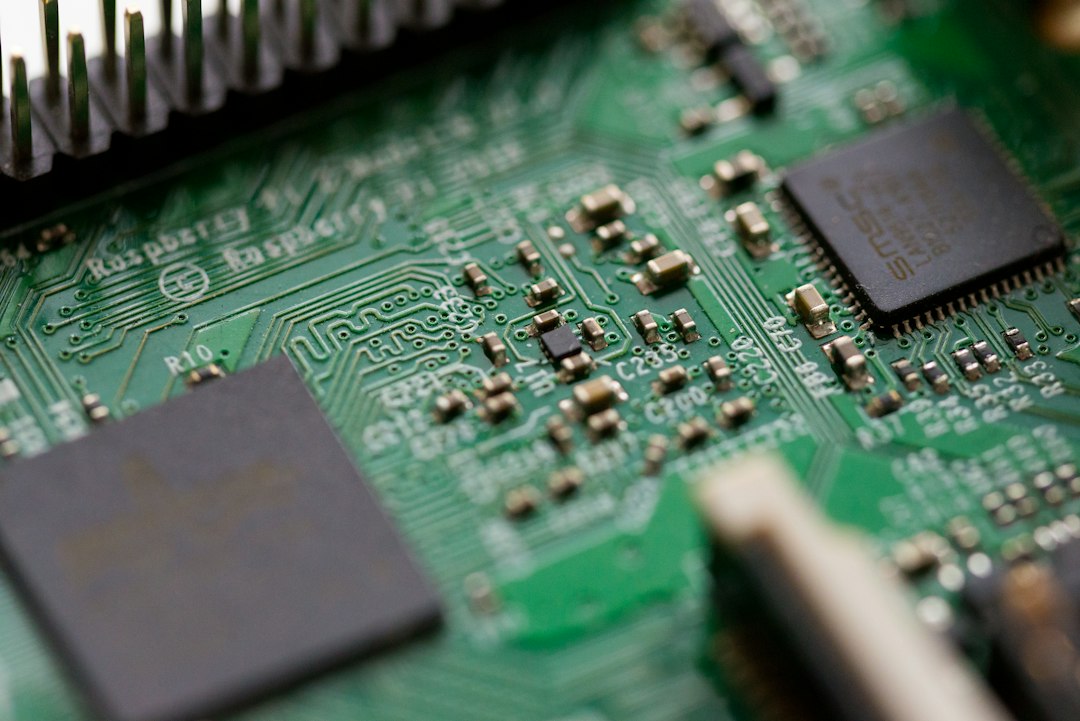
Photo by Chris Ried on Unsplash
FPGA SmartNICs: Reconfigurable Hardware Acceleration at the Network Edge
When CPU cycles become the bottleneck for network-intensive workloads, the next optimization target is the network interface card itself. FPGA-based SmartNICs represent a convergence of programmable hardware and network acceleration, offloading packet processing and application logic to reconfigurable silicon that sits directly in the data path.
Unlike fixed-function ASICs or CPU-based DPU SmartNICs, FPGA SmartNICs provide hardware-level performance with the ability to reprogram the logic after deployment. This combination addresses a specific problem: workloads that need line-rate processing at 100 Gbps or beyond, with latency measured in microseconds, but whose requirements evolve too quickly for hardened silicon.
Why FPGAs at the NIC Layer
Traditional network stacks impose unavoidable overhead. Each packet traverses kernel buffers, protocol layers, and context switches before reaching application code. Even with kernel bypass techniques like DPDK, the host CPU remains in the critical path, burning cycles on packet inspection, protocol parsing, and state management.
FPGA SmartNICs move this work into hardware that processes packets as they arrive on the wire. The FPGA logic operates in parallel with wire speed—no scheduling delays, no cache misses, no operating system interference. For certain workloads, this eliminates the CPU from packet processing entirely.
The reconfigurability matters because data center requirements shift. A card deployed for RDMA offload today might need inline encryption tomorrow, or machine learning inference for DDoS detection next quarter. FPGA bitstreams can be updated in the field, retargeting the same hardware for different acceleration tasks without replacing physical devices.
Workload Fit and Tradeoffs
FPGA SmartNICs excel at tasks with predictable, parallelizable data flow: packet filtering and classification, protocol parsing and header manipulation, stateful connection tracking, encryption and hashing, RDMA protocol engines, and inline compression or decompression. Research implementations have demonstrated SYN flood detection using machine learning inference at line rate, distributed transaction coordination through replicated data types, and SDN policy evaluation that would otherwise saturate host CPUs.
The tradeoff is complexity. Writing FPGA logic requires hardware description languages like Verilog or VHDL, or higher-level synthesis tools that compile restricted subsets of C++ to hardware. Development cycles are longer than software. Debugging requires different tooling. Power and thermal constraints limit logic density. Not every algorithm maps efficiently to FPGA architectures—irregular memory access patterns, deep control flow branching, and large lookup tables can underperform CPU implementations.
Latency characteristics differ from CPUs as well. FPGAs deliver consistent, deterministic latency measured in nanoseconds for operations that fit entirely in hardware. But any fallback to host software incurs PCIe round-trip overhead, often adding microseconds. The performance model requires careful partitioning: fast path in hardware, slow path or management plane on the host.
Architecture and Integration
FPGA SmartNICs typically pair a network MAC and PHY layer with configurable FPGA fabric and a PCIe interface to the host. Some designs include embedded ARM cores for control plane tasks, reducing reliance on host CPU for configuration and telemetry. The FPGA logic sits inline between the network and host memory, inspecting or transforming packets before DMA to host buffers.
Shells or frameworks provide reusable infrastructure: PCIe DMA engines, network protocol parsing blocks, memory controllers, and register interfaces. Application developers program custom compute logic that plugs into these shells, handling domain-specific acceleration without rebuilding the entire network stack from scratch. RecoNIC, for example, integrates a RoCEv2-compliant RDMA engine with programmable compute blocks for network-attached computation.
The integration challenge is software compatibility. Applications must be aware of offload capabilities, either through explicit APIs or transparent kernel drivers that intercept and redirect traffic. Managing bitstream updates, monitoring FPGA health, and debugging hardware-software interactions require operational tooling that most organizations lack.
Deployment Context
FPGA SmartNICs fit a specific economic and technical niche. Cloud providers and hyperscalers use them for tenant isolation, inline security, and protocol offload where CPU cost at scale justifies development investment. High-frequency trading, real-time telemetry processing, and security appliances adopt them for latency guarantees that software cannot meet. Research and defense applications value reconfigurability for rapidly evolving algorithms.
For general-purpose application acceleration, CPU or GPU offload often provides better developer productivity. For fixed workloads at scale, custom ASICs deliver better power efficiency. FPGA SmartNICs occupy the middle: workloads that need hardware performance but cannot tolerate ASIC development timelines or fixed functionality.
The choice hinges on whether the workload bottleneck is truly in packet processing, whether the logic fits FPGA constraints, and whether the organization can sustain FPGA development expertise. When those conditions align, FPGA SmartNICs deliver acceleration that neither software nor fixed silicon can match.