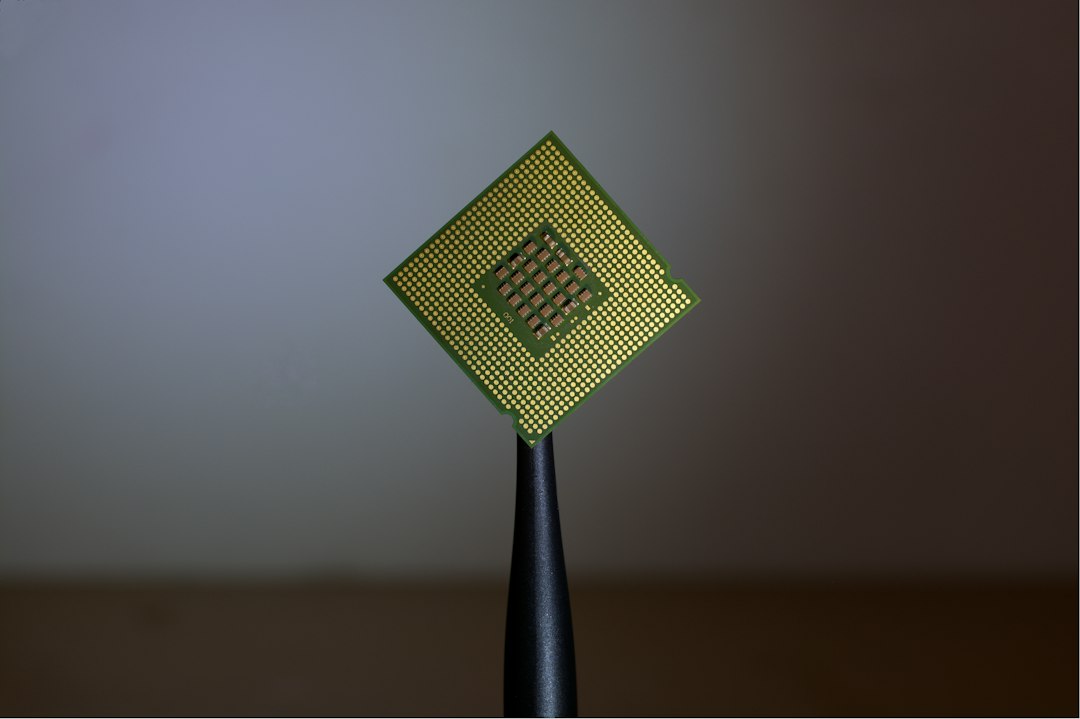
Photo by Brian Kostiuk on Unsplash
Instruction-Level Parallelism: How CPUs Execute Multiple Operations Per Clock
A modern CPU core can execute four, five, or even six instructions in a single clock cycle despite running what appears to be strictly sequential code. This capability, called instruction-level parallelism (ILP), is one of the most important performance optimizations in processor design, yet it remains largely invisible to developers who don’t work in performance-critical domains.
Superscalar Execution
The term “superscalar” describes a processor that can dispatch multiple instructions per cycle to different execution units. A typical high-performance core today contains separate units for integer arithmetic, floating-point operations, address calculation, and branch resolution. While a single-issue processor would handle these operations one at a time, a superscalar design identifies independent instructions in the instruction stream and launches them simultaneously.
The key constraint is data dependency. If instruction B reads a value that instruction A writes, B cannot start until A completes. But if instructions A, B, C, and D operate on entirely separate registers, all four can proceed in parallel across different execution units. The processor’s front-end decodes incoming instructions, identifies these opportunities, and dispatches work accordingly.
Out-of-Order Execution
Superscalar dispatch alone only captures parallelism among adjacent instructions. Out-of-order execution extends this by allowing instructions further down the stream to bypass stalled predecessors. If instruction 5 waits on a memory load while instructions 6 through 10 are ready, the processor can execute those later instructions first and apply their results in program order later.
This requires a reorder buffer that tracks in-flight instructions and their dependencies. When an instruction completes, the processor checks whether all earlier instructions have also finished. Only then does it commit the result to architectural state, preserving the illusion of sequential execution even though operations occurred out of sequence internally.
The benefit is substantial: memory latency, which might stall a simple in-order core for hundreds of cycles, can be hidden if the processor finds enough independent work to fill that window.
Register Renaming
A significant obstacle to ILP is false dependencies caused by register reuse. If instruction A writes to register R1, instruction B reads R1, and instruction C writes R1 again, the processor sees a dependency chain even though C’s write has no logical relationship to A’s.
Register renaming solves this by mapping architectural registers (the ones the program uses) to a larger pool of physical registers. When instruction C writes R1, the renaming logic allocates a fresh physical register, breaking the false dependency. B still reads the physical register that A wrote, while C writes a different one. Later instructions that reference R1 automatically use C’s mapping.
This increases the processor’s ability to find independent instructions, often doubling or tripling effective ILP on real workloads.
Width and Limits
Modern high-performance cores can decode, rename, and dispatch between four and eight instructions per cycle, with reorder buffers tracking several hundred in-flight operations. But real-world ILP rarely approaches these theoretical limits. Actual code contains branches, memory dependencies, and long dependency chains that constrain parallelism. Measured ILP on typical applications ranges from 2 to 3 instructions per cycle, even on six-wide designs.
Compiler optimizations such as loop unrolling, software pipelining, and careful instruction scheduling attempt to expose more ILP by restructuring code to minimize dependencies. But ultimately, the structure of the algorithm itself determines how much parallelism exists.
Why It Matters
ILP is the reason single-threaded performance continued improving for decades even as clock speeds plateaued. It’s also why latency-sensitive operations—database queries, request handling, UI interaction—benefit from high-performance cores even when only one thread is active.
Understanding ILP helps explain why certain code patterns perform better than others: tight loops with independent iterations exploit it well, while pointer-chasing through linked structures defeats it. The processor can only accelerate what the code allows.