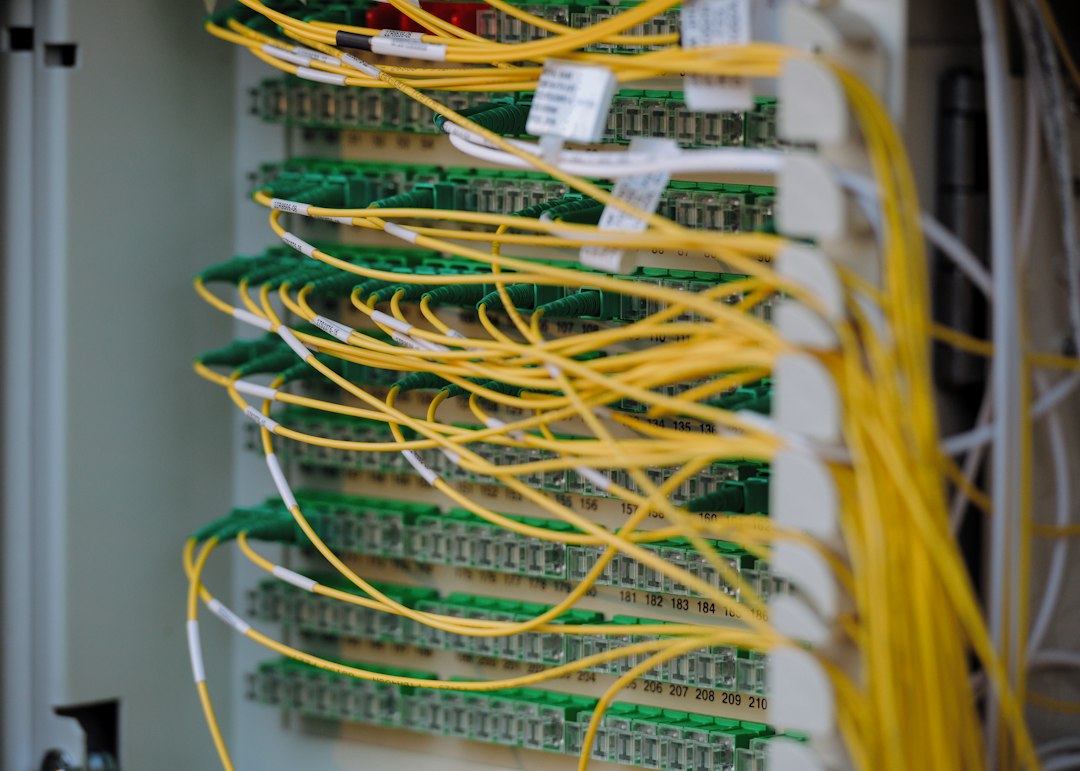
Photo by Albert Stoynov on Unsplash
RDMA Verbs API: Why Direct Memory Access Stays Niche
Remote Direct Memory Access (RDMA) delivers some of the most impressive latency and throughput numbers in modern networking, but its adoption remains concentrated in a handful of specialized domains: high-frequency trading, distributed storage backends, and HPC clusters. The core barrier isn’t hardware cost or network infrastructure. It’s the programming model.
The Verbs API: Low-Level by Design
RDMA exposes hardware capabilities through the Verbs API, a low-level interface originally designed for InfiniBand and later extended to RoCE (RDMA over Converged Ethernet) and iWARP. Unlike socket-based programming, Verbs requires explicit management of queue pairs, completion queues, memory registration, and protection domains. There’s no kernel handholding—applications allocate buffers, pin them in physical memory, register them with the NIC, and post work requests directly to hardware queues.
This design eliminates kernel context switches and enables true zero-copy transfers, but it also means developers must reason about hardware state machines, handle asynchronous completion polling, and manage memory visibility across NUMA domains. The API surface is large, with dozens of setup calls before the first byte moves. A typical TCP socket program might initialize in five lines; the equivalent RDMA setup spans hundreds, touching device contexts, protection domains, queue pair attributes, and memory region permissions.
Memory Registration and the Pinning Tax
One of the trickiest parts of RDMA programming is memory registration. Before a buffer can be used for RDMA operations, it must be registered with the RDMA hardware, which pins the pages in physical memory and creates translation entries in the NIC’s memory management unit. This registration is expensive—often milliseconds per buffer—so applications must amortize the cost by reusing registered regions or maintaining memory pools.
The memory semantics are strict. Registered memory cannot be swapped or moved by the kernel, which limits the operating system’s ability to manage resources dynamically. For applications with large working sets or unpredictable allocation patterns, this creates tension between RDMA’s performance promise and practical memory management. Some storage systems solve this with dedicated RDMA buffer pools, but that adds another layer of complexity and resource fragmentation.
One-Sided Operations and the Coordination Problem
RDMA supports one-sided operations—reads and writes that complete without involving the remote CPU. This is powerful for latency-sensitive workloads, but it introduces coordination challenges. With TCP, both sides of a connection run code that processes data. With one-sided RDMA, the remote side is passive; the initiator reads or writes memory directly. This shifts responsibility for synchronization, ordering, and consistency entirely to the application.
Distributed databases using RDMA must implement their own flow control, acknowledgment protocols, and memory visibility guarantees. There’s no TCP-style reliability layer, so dropped packets or completion queue overflows become application concerns. The result is that RDMA often gets wrapped in higher-level frameworks—like HERD, FaRM, or eRPC—that rebuild much of what traditional networking stacks provided, just optimized for RDMA semantics.
Tooling and Debugging Gaps
Network debugging with RDMA is sparse compared to TCP/IP. Standard tools like tcpdump and Wireshark offer limited RDMA introspection. Completion queue errors are opaque; a failed work request might return a generic transport retry counter exceeded message with no indication of which packet, which route, or which policy failed. Profiling tools that understand RDMA queue depths, memory region contention, or PCIe bandwidth saturation are rare.
The result is that debugging RDMA programs often requires vendor-specific utilities, hardware counters, and deep knowledge of NIC microarchitecture. For teams without dedicated networking expertise, this is a significant barrier. Issues that would take minutes to diagnose with packet captures can take hours with RDMA.
Where RDMA Wins Anyway
Despite these challenges, RDMA thrives in environments where the performance gains justify the complexity. Distributed key-value stores like RAMCloud and FaRM achieve sub-microsecond read latencies by exploiting one-sided RDMA reads. Storage disaggregation projects use RDMA to make remote NVMe feel local. These systems invest heavily in RDMA-aware data structures and protocols, but the payoff is a step-function improvement in throughput and tail latency.
The takeaway: RDMA is not a drop-in replacement for sockets. It’s a specialty tool that demands architectural commitment, careful memory management, and expertise in both distributed systems and hardware behavior. For the few workloads that truly need it, the juice is worth the squeeze. For everyone else, the Verbs API remains a curiosity just beyond the abstraction boundary.