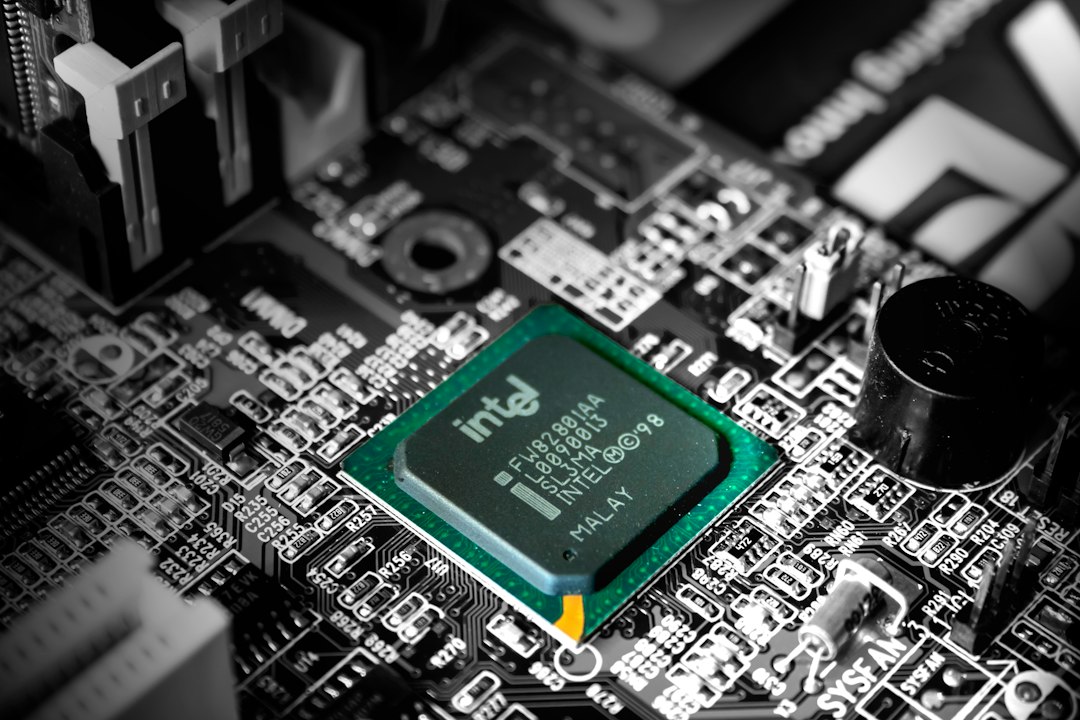
Photo by Slejven Djurakovic on Unsplash
SIMD Auto-Vectorization: Why Compilers Still Need Your Help
Modern CPUs ship with SIMD (Single Instruction, Multiple Data) units capable of processing multiple values in parallel with a single instruction. A 256-bit AVX2 register can operate on eight 32-bit floats simultaneously, and AVX-512 doubles that. These instructions can deliver dramatic speedups for data-parallel workloads, sometimes approaching order-of-magnitude improvements for operations like image processing, numerical computation, or data transformation.
Compilers have supported auto-vectorization for years—the ability to automatically transform scalar loops into SIMD instructions without explicit intrinsics or assembly. Yet developers working on performance-critical code quickly learn that auto-vectorization remains frustratingly unreliable. The compiler often fails to vectorize code that seems obviously parallel, or produces suboptimal SIMD code that’s slower than the scalar version.
The Aliasing Problem
The most common reason compilers fail to vectorize is pointer aliasing. When a loop processes memory through pointers, the compiler must prove that writes through one pointer cannot affect reads through another. Without this proof, vectorization becomes unsafe.
Consider a simple loop that adds two arrays. If the output array overlaps with one of the inputs in memory, processing multiple elements simultaneously could read values that were just written by an earlier iteration within the same SIMD operation. The compiler cannot assume independence unless you explicitly tell it the pointers don’t alias—through language extensions like C’s restrict keyword or by analyzing the code path end-to-end.
Control Flow Breaks Vectorization
SIMD works best with straight-line code. Introduce a conditional inside a loop, and the compiler faces a dilemma. Modern SIMD units support predicated execution through masking, where each lane can be conditionally disabled, but generating efficient masked code is complex. The compiler must determine whether masking overhead outweighs the benefit of vectorization.
Early exits, nested conditionals, or function calls inside loops make this analysis even harder. Many compilers simply give up, falling back to scalar code rather than attempting to generate masked SIMD instructions that might perform worse than the original loop.
Unknown Trip Counts and Alignment
Effective SIMD code requires handling partial vectors at loop boundaries. If your loop processes 1,000 elements and your SIMD width is eight, the compiler needs to generate a main vectorized loop plus scalar cleanup code for the remaining elements. When the trip count is unknown at compile time, this adds code size and complexity.
Memory alignment matters too. Unaligned loads and stores are supported on modern x86 CPUs but may incur performance penalties on some microarchitectures or under certain conditions. Compilers often refuse to vectorize unless they can prove alignment, or they generate multiple code paths with runtime alignment checks, adding overhead that can negate SIMD benefits for small arrays.
Cost Model Uncertainty
Compilers maintain internal cost models to predict whether vectorization will improve performance. These models must account for the overhead of vector setup, increased register pressure, potential memory bandwidth saturation, and the possibility that SIMD instructions have higher latency than their scalar equivalents on some CPUs.
These models are necessarily conservative and often wrong. A compiler might refuse to vectorize a loop because its cost model predicts slowdown, when in practice the code would run faster. Or it might vectorize aggressively and hurt performance by evicting hot data from registers or cache.
Function Boundaries Block Analysis
When a loop calls a function, the compiler loses visibility unless it can inline that function. If inlining fails—because the function is too large, in a different translation unit, or behind a function pointer—the compiler cannot reason about side effects or memory access patterns inside that function.
Even when inlining succeeds, deep call chains or recursive functions can exceed the compiler’s analysis budget. Interprocedural optimization helps but has limits, especially in large codebases where whole-program analysis is impractical.
What Actually Works
Developers who need reliable SIMD performance typically abandon auto-vectorization in favor of explicit approaches. Hand-written intrinsics give complete control but are verbose and architecture-specific. Libraries like Highway provide portable SIMD abstractions. Some domains use DSLs or code generators that emit optimized SIMD code.
Newer languages experiment with better primitives—explicit parallel loops, pure functions that simplify analysis, or first-class SIMD types with guaranteed semantics. These approaches acknowledge that automatic SIMD is fundamentally difficult and instead focus on making explicit SIMD easier to write and maintain.
Auto-vectorization remains a useful optimization for simple loops over contiguous arrays with no control flow, but anything more complex typically requires developer intervention. The gap between what theoretically could vectorize and what compilers actually vectorize remains wide, and fundamental analysis challenges suggest it will stay that way.