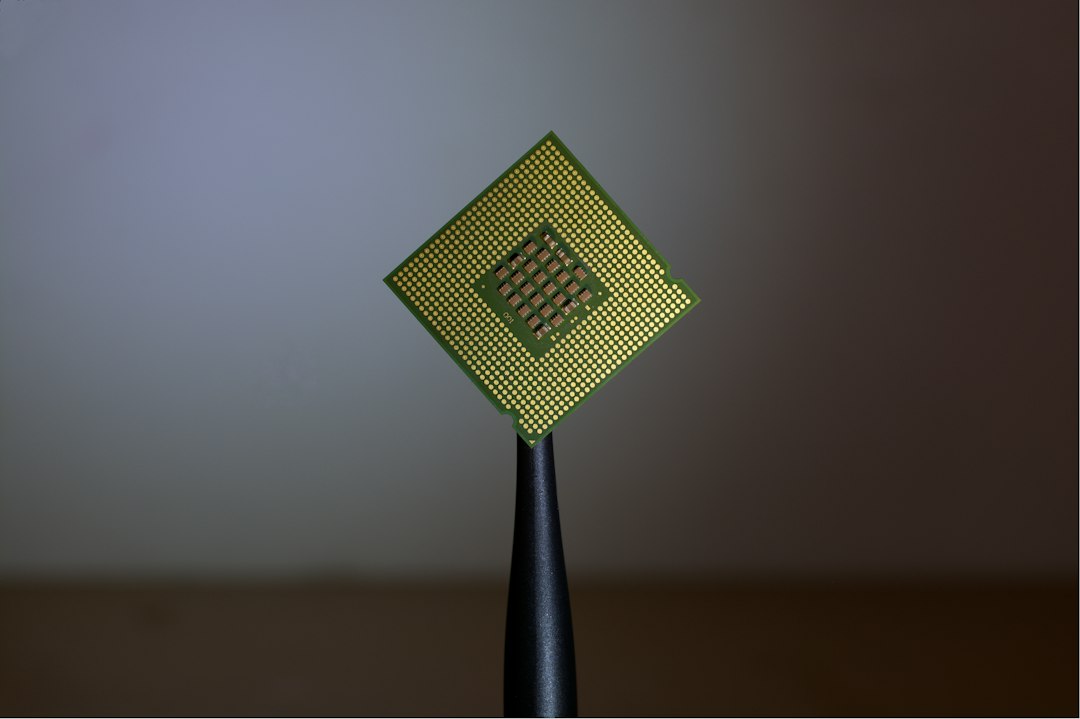
Photo by Brian Kostiuk on Unsplash
SIMD: Parallel Data Processing Inside a Single Instruction
Modern CPUs don’t just execute instructions one at a time on one piece of data. They pack multiple operations into a single instruction cycle using SIMD—Single Instruction, Multiple Data. This architectural pattern lets processors apply the same operation to multiple data points simultaneously, often delivering 4x, 8x, or even 16x speedups for workloads that fit the model.
How SIMD Works
Traditional scalar instructions operate on one value at a time. Add two numbers, get one result. SIMD instructions instead operate on vectors of values packed into wide registers. A single instruction might add eight integers or four floating-point numbers in parallel, all within one CPU cycle.
Intel’s SSE, AVX, and AVX-512 instruction sets, ARM’s NEON, and RISC-V’s vector extensions all implement SIMD with varying register widths and supported operations. AVX-512, for instance, uses 512-bit registers that can hold sixteen 32-bit floats or eight 64-bit integers, processing all of them with a single instruction.
The constraint is right there in the name: you’re running the same instruction across multiple data points. This works brilliantly for uniform operations—image processing, audio encoding, matrix multiplication, cryptographic operations, and numerical simulations all fit naturally. It doesn’t help when each data element needs different logic or unpredictable branching.
Where SIMD Delivers
Video codecs lean heavily on SIMD. Encoding and decoding frames involves applying transforms, quantization, and filtering across millions of pixels. Each pixel gets the same operation, making it a textbook SIMD workload. H.264, H.265, and AV1 codecs all optimize their hot paths with SIMD intrinsics.
Database engines use SIMD for filtering, hashing, and aggregation. Scanning millions of rows to find matches, computing hash values for joins, or summing columns are all embarrassingly parallel operations. PostgreSQL, DuckDB, and ClickHouse use SIMD to accelerate query execution, sometimes cutting scan times in half.
Machine learning frameworks use SIMD for tensor operations before offloading to GPUs. Even on CPUs, matrix multiplies and convolutions benefit from vectorized loops. Libraries like Intel MKL and OpenBLAS are packed with hand-tuned SIMD kernels.
Compression and hashing algorithms are another natural fit. LZ4, Zstd, and BLAKE3 all include SIMD-optimized paths. BLAKE3 specifically designed its algorithm to take advantage of wide vector operations, achieving multi-gigabyte-per-second hashing speeds on modern CPUs.
The Compiler and the Hand-Written Path
Compilers can auto-vectorize loops under the right conditions—simple iteration patterns, no aliasing, predictable data access. But they’re conservative. Ambiguous pointer semantics, complex control flow, or unaligned memory access often prevent vectorization.
Performance-critical code often drops down to intrinsics or assembly. Intrinsics give direct access to SIMD instructions while staying in C or C++, letting developers write vectorized code that compilers won’t second-guess. The tradeoff is portability: AVX-512 intrinsics won’t run on older CPUs or ARM processors. Libraries typically ship multiple code paths and select at runtime based on CPU feature detection.
SIMD’s Limits
SIMD only helps when you have enough parallel, uniform work. Small datasets don’t justify the setup cost. Irregular workloads with divergent control flow waste SIMD lanes—if only three of eight elements need processing, the other five sit idle.
Memory bandwidth can become the bottleneck. If you’re loading data faster than memory can supply it, wider SIMD registers just mean more time waiting. Cache-friendly data layouts and prefetching matter as much as instruction choice.
SIMD also fragments across architectures. Code optimized for AVX-512 needs a fallback for older x86 chips, a different implementation for ARM NEON, and yet another for RISC-V vectors. This complexity is why most developers rely on libraries that handle the branching internally.
Why It Still Matters
Despite GPU dominance in parallel computing, SIMD remains essential. Not every workload justifies moving data to a discrete accelerator. For in-process operations—parsing JSON, compressing responses, filtering logs—SIMD acceleration is immediate, with no data transfer overhead.
As vector register widths grow and instruction sets mature, SIMD is becoming more accessible. ARM’s Scalable Vector Extension lets code adapt to different register sizes without recompilation. RISC-V’s vector extension takes a similar approach, aiming for portability across implementations.
SIMD isn’t exotic. It’s a fundamental tool for making CPUs work harder on data-parallel problems, delivering meaningful speedups without leaving the processor. When the operation is uniform and the data is ready, few optimizations pay off faster.