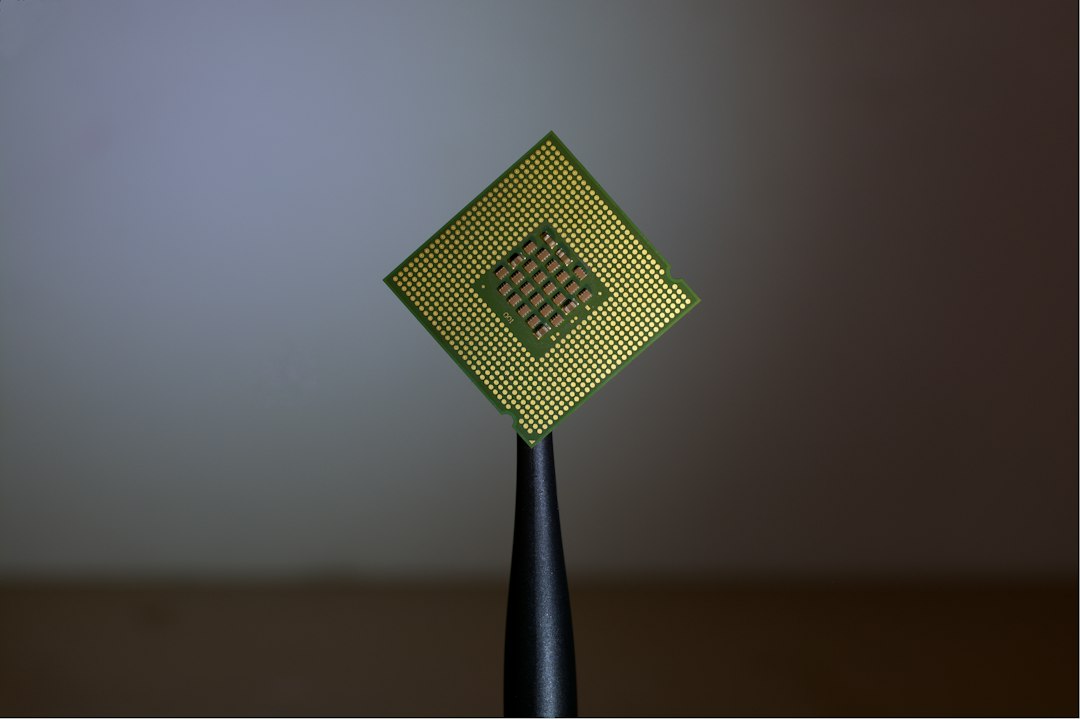
Photo by Brian Kostiuk on Unsplash
SIMD Width Evolution: Why 512-bit Vectors Haven't Replaced 256-bit
Single instruction, multiple data (SIMD) extensions let CPUs perform the same operation on multiple values simultaneously. Modern x86 processors support several vector widths: 128-bit SSE, 256-bit AVX2, and 512-bit AVX-512. In theory, doubling vector width should double throughput for vectorizable workloads. In practice, wider isn’t always faster, and the industry’s relationship with 512-bit vectors reveals important tradeoffs in processor design.
Power and Frequency Penalties
Executing 512-bit vector instructions requires significantly more transistor activity than narrower operations. This increased power draw triggers thermal constraints that force the CPU to reduce its clock frequency, a phenomenon called frequency downclocking or AVX offset.
On many Intel server processors, sustained AVX-512 workloads can drop frequency by 200-400 MHz compared to lighter workloads. This means that while each instruction processes twice the data compared to 256-bit AVX2, it may execute at 10-15% lower frequency. For workloads that don’t achieve near-perfect vectorization, or that alternate between scalar and vector code, the net effect can be a performance loss rather than gain.
The power budget matters even more in thermally constrained environments like laptops and dense server configurations. Running hot vector units can throttle not just the core executing SIMD instructions, but neighboring cores sharing the same voltage domain, impacting overall system throughput.
Die Area and Design Complexity
Wider execution units consume proportionally more silicon area. A 512-bit FPU is substantially larger than a 256-bit unit, and that area could alternatively house more cores, larger caches, or additional functional units.
For workloads that can’t fully utilize 512-bit vectors—either due to insufficient parallelism in the algorithm or limitations in memory bandwidth—this silicon investment yields diminishing returns. Chip designers must balance the peak throughput of wide SIMD against the aggregate throughput of simpler, more numerous execution resources.
This tradeoff helps explain why Apple’s M-series chips and ARM’s Neoverse cores have largely standardized on 128-bit NEON vectors despite their high performance in many domains. The area and power saved by narrower vectors enables other optimizations that provide more consistent wins across diverse workloads.
Memory Bandwidth Bottlenecks
SIMD throughput is only valuable if data can be fed to the execution units fast enough. A 512-bit vector unit operating at 2 GHz theoretically demands 128 GB/s of memory bandwidth per core for sustained single-precision floating-point operations. Most systems can’t deliver that.
When memory bandwidth saturates, wider vectors don’t improve throughput—they just drain the available data faster and then stall waiting for more. In these scenarios, narrower vectors running at higher frequency, or more cores sharing the same memory bandwidth, often deliver better aggregate performance.
This is particularly relevant for high-performance computing and machine learning workloads, where data movement costs frequently dominate arithmetic intensity. Optimizing memory access patterns, cache utilization, and data reuse often matters more than raw vector width.
Software and Ecosystem Inertia
Compilers can auto-vectorize many loops, but reliably extracting maximum performance from 512-bit vectors often requires hand-written intrinsics or assembly. Many codebases target 256-bit as the practical ceiling for portable, maintainable SIMD code, since AVX2 is broadly supported across Intel and AMD processors spanning a decade.
AVX-512 also fragments into a complex set of optional sub-features (AVX-512F, AVX-512BW, AVX-512VL, etc.), making feature detection and code dispatching more intricate. Libraries that invested in AVX2 optimizations face a high bar to justify rewriting for AVX-512, especially when gains are workload-dependent and the instruction set’s availability remains inconsistent.
Intel’s recent decision to drop AVX-512 from performance cores in hybrid architectures like Alder Lake further complicates the software story. Developers targeting mainstream client processors must now assume 256-bit as the maximum portable width.
The Right Width for the Job
Vector width is one dimension in a multi-faceted design space that includes frequency, core count, cache hierarchy, memory bandwidth, power envelope, and software maturity. The optimal choice depends on the workload’s arithmetic intensity, memory access patterns, and degree of parallelism.
For domains like dense linear algebra with high data reuse, 512-bit vectors can deliver substantial wins. For irregular, memory-bound, or mixed-workload scenarios, narrower vectors paired with higher frequency and better power efficiency often perform better in practice.
The lesson isn’t that 512-bit is bad—it’s that width alone doesn’t determine performance, and the tradeoffs required to support ultra-wide vectors may cost more than they deliver outside specialized niches.